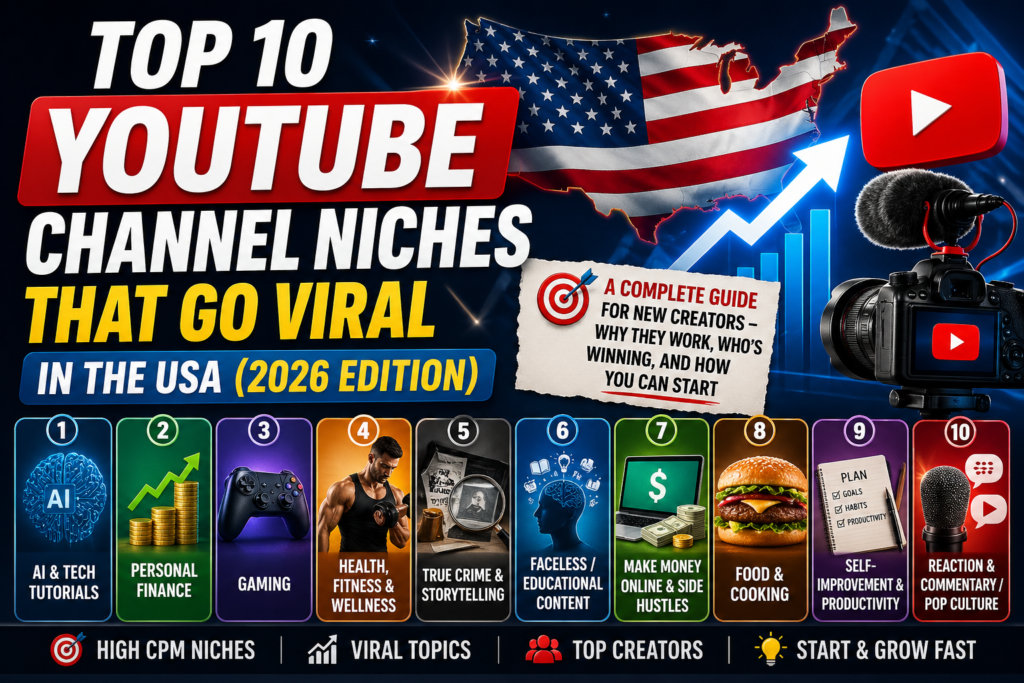
There is a comprehensive guide for new creators that explains how it works, who is finding success, and how you can get started.
First and foremost, you should be aware that more than 2.8 billion people visit YouTube every month. It is the second most-visited website in the world, and the United States serves as its largest and most lucrative market.
However, there is a harsh reality that every new creator needs to know: if you choose the wrong niche, your channel will fizzle out before it ever reaches an audience.
The difference between a channel that hits 100,000 subscribers in a single year and one that crawls along with a mere 200 views per video is rarely a matter of talent or editing skills; it is, invariably, a difference in niche selection.
Some niches benefit from the momentum of the algorithm, high demand from advertisers, and passionate communities that share content extensively. Conversely, other niches resemble a desert—places where even the most exceptional videos vanish without a trace.
In today’s Creator Factory guide, we will delve into the top 10 YouTube niches that are consistently going viral in the USA in 2026. We will also explain how each niche functions—both psychologically and algorithmically—identify which channels are currently dominating these spaces, and outline the steps a new creator should take to enter these fields and compete effectively.
What Makes a Niche Go “Viral” in the USA?
Before proceeding further with this list, it is crucial to understand how something goes viral. American YouTube viewers share content when it evokes one or more of the following emotional aspects:
- Curiosity — “I never knew that.” Educational and explainer content.
- Aspiration — “I want that life.” Finance, fitness, and productivity content.
- Identity — “This is so me.” Gaming, lifestyle, and pop culture content.
- Urgency — “I need to watch this right now.” Breaking news, drama, and trending events.
- Entertainment — “I couldn’t stop laughing.” Comedy, challenge, and reaction content.
The niches with the highest potential to go viral are those that combine at least two of these triggers with high advertiser demand (measured in CPM—Cost Per Thousand Impressions) and compatibility with the YouTube algorithm (characterized by a strong click-through rate, high watch time, and high viewer retention).
With this framework in mind, we have listed below the 10 niches that are currently dominating the USA.
1. AI & Technology Tutorials
Artificial intelligence is reshaping every industry, and American audiences—from college students to seasoned professionals—are eager to understand it.
Whenever a major AI tool is launched (such as a new ChatGPT update, an image generator, or an automation platform), its YouTube search volume skyrockets within just a few hours.
This sector benefits from what analysts term “evergreen urgency”: the subject matter remains perpetually relevant, yet—given the rapid pace of technological evolution—individual videos feel timely and current.
AI and tech tutorial channels command premium CPM rates of approximately $15–$22 per thousand views, as tech advertisers—including software companies, SaaS platforms, and online course providers—are willing to pay a premium to reach an educated, high-income audience.
Who Is Doing Well
- Matt Wolfe — Covers AI tools with a calm, accessible style. Grew to over 1 million subscribers rapidly by focusing on practical tutorials.
- Two Minute Papers — Academic AI research made digestible. Beloved by tech professionals.
- Marques Brownlee (MKBHD) — The gold standard of tech reviews, with over 18 million subscribers. He sets the benchmark for production quality in this space.
Tips for New Creators
You don’t need to be a software engineer. You simply need the ability to explain complex AI tools in simple language.
Choose a specific sub-niche—such as AI for content creators, AI for small business owners, or AI productivity hacks—and master it completely.
Whenever a major tool is released, understand it and post about it immediately to capitalize on the algorithm’s momentum.
In this niche, channels that feature only screen recordings and voiceovers—without ever showing your face—also perform exceptionally well.
2. Personal Finance & Investing
Money is one of the most emotionally charged subjects in human life. American audiences are constantly preoccupied with debt, retirement, wealth-building, and financial freedom—and they turn to YouTube for answers.
Content related to personal finance evokes a dual response in people: a sense of hope (“I want to become wealthy”) and a sense of urgency (“I need to fix my situation right now”).
Titles such as “How I Paid Off $60,000 in Debt in 2 Years” or “Why the Middle Class Will Never Build Wealth” practically compel people to click.
This is the topic with the highest CPM across all of YouTube. Finance-related advertisers—such as banks, brokerage platforms, insurance companies, and fintech apps—offer CPMs ranging from $15 to $22; this means that content creators in this niche earn significantly more than those in any other category.
Who Is Doing Well
- Graham Stephan — Real estate investor turned finance educator. Built a massive audience discussing credit cards, savings, and investing.
- Andrei Jikh — Known for combining stunning visual style with finance education. Covers crypto, stocks, and personal finance for younger audiences.
- The Ramsey Show — Dave Ramsey’s team repurposes podcast content into YouTube clips that consistently rack up millions of views.
Tips for New Creators
First, understand this clearly: you don’t need to be a millionaire to teach finance. You simply need to stay one step ahead of your audience.
Focus on a specific group—Gen Z first-time investors, millennials paying off student loans, or side-hustlers building their first emergency fund.
Here, your authenticity matters more than your credentials. Sharing your own genuine story—including your failures—builds trust far more quickly than any professional certification ever could.
3. Gaming
Gaming is the largest entertainment category on YouTube in terms of volume.
Globally, more than 500 million monthly active users engage with gaming content. In the USA, gaming culture is widespread across people of all ages and demographic groups.
Gaming content thrives in a variety of formats—such as gameplay walkthroughs, speedruns, live reactions, deep dives into game narratives, tier lists, and much more—offering creators tremendous flexibility in content creation.
This specific niche within gaming is highly effective for building a community. Gaming audiences are exceptionally loyal; they subscribe not only for the games themselves but also for the creator’s personality and commentary style.
Who Is Doing Well
- MrBeast Gaming — A sub-channel of the MrBeast empire, combining gaming content with the signature challenge format. Earns an estimated $32–48 million annually across his channels.
- PewDiePie — The original gaming YouTube giant. Still active with 111 million subscribers, proving long-term audience loyalty in this space.
- Dream — Built a massive audience around Minecraft content, particularly his “Minecraft Manhunt” series format, which created a replicable, binge-worthy structure.
Tips for New Creators
Do not attempt to compete with major channels when it comes to popular games. Instead, focus your entire attention on a specific type of game.
Choose a game that boasts a highly passionate community, yet lacks high-quality content on YouTube. Alternatively, focus on a unique format—such as “I Played Game X for 100 Days, and Here’s What Happened”—which creates a natural narrative structure that keeps viewers hooked.
In the gaming niche, your personality matters immensely; your commentary style is your true product.
4. Health, Fitness & Wellness
Content related to health and fitness addresses one of the most fundamental human needs: looking and feeling better. Throughout the year, American audiences search in large numbers for workout routines, nutritional advice, weight-loss success stories, and mental health guidance.
This fitness niche is particularly effective on YouTube Shorts, where “before-and-after” transformation clips frequently go viral on their own.
What makes this field especially appealing is the immense scope it offers for monetization opportunities.
Beyond ad revenue (yielding a CPM of $5–10), fitness content creators can establish multiple diverse income streams by selling their own merchandise, supplements, online courses, and coaching programs.
Who Is Doing Well
- Jeff Nippard — Science-based fitness content. His evidence-driven approach distinguishes him from generic workout channels and attracts an educated audience.
- Athlean-X (Jeff Cavaliere) — A physical therapist and trainer who built one of the most trusted fitness channels on the platform with over 14 million subscribers.
- Yoga With Adriene — Proof that wellness content is not just about muscle. Her calming, accessible yoga content has built a loyal global community.
Tips for New Creators
Choose a specific niche: for instance, powerlifting for beginners, running for busy parents, at-home workouts without equipment, or meal prep for weight loss.
The more specific your audience is, the faster you will be able to build your community.
Honestly showcase the transformations you experience yourself—in this field, this type of content is the most shareable.
Rather than a professional studio setup, high-quality yet simple production (good lighting, clear audio) is what truly matters.
5. True Crime & Storytelling
True crime stories constitute one of the most captivating content genres in American culture. YouTube’s algorithm favors this heavily because true crime videos generate exceptionally high watch time—viewers rarely abandon the story midway.
These videos foster a strong emotional connection; viewers rapidly experience feelings of fear, outrage, fascination, and relief. Sharing true crime-related content is akin to telling a friend, “You won’t believe this story.”
True crime channels also command high CPMs (ranging from $8 to $15, depending on the sub-category) because they attract an audience in the 25–54 age demographic—a demographic of immense value to advertisers.
Who Is Doing Well
- Stephanie Harlowe — One of the most respected independent true crime creators, known for thorough research and ethical storytelling.
- Crime Junkie (podcast crossover) — The podcast’s YouTube presence shows how cross-platform true crime brands build massive audiences.
- JCS – Criminal Psychology — Brilliant analysis of police interrogation videos. Demonstrates how a sub-niche within true crime can dominate.
Tips for New Creators
An ethical approach to storytelling is not merely an option—it is a strategic advantage. Audiences are increasingly rejecting exploitative crime-related content that treats victims with insensitivity.
Conduct thorough research, credit your sources, and adopt a compassionate perspective toward victims. You can begin this process anonymously by utilizing publicly available footage and voiceover narration, thereby bringing production costs down to nearly zero.
6. Faceless / Narration & Educational Content
Faceless content is a massive trend in the US, as it lowers the barrier to entry for creators while simultaneously enabling high-quality, scalable storytelling.
Faceless channels cover a wide range of topics—from history and science to business case studies and “cheating and revenge” stories—by utilizing voiceover narration paired with stock footage, animations, or relevant B-roll.
The statistics behind this specific niche are staggering. Channels featuring “cheating and revenge” stories currently generate the highest RPM on YouTube—estimated at approximately $12.82 per thousand views—because they combine long watch times (stories lasting 8–15 minutes keep viewers hooked) with advertiser-friendly content.
Similarly, educational explainer channels also benefit from premium advertisers who are actively seeking out an eager and curious audience.
Who Is Doing Well
- Wendover Productions — Geography, logistics, and global systems explained visually. A masterclass in faceless educational content.
- Cold Fusion — Business and technology storytelling. Over 5 million subscribers with no face on camera.
- Bright Side — One of the most-subscribed faceless channels on the platform, covering psychology, science, and life hacks.
Tips for New Creators
Choose a topic on which you can write a compelling script. If you manage to write an excellent script, consider 80% of the work done.
Invest in high-quality voiceovers (either use your own voice with a good microphone or utilize professional AI voiceover tools), and incorporate B-roll and motion graphics to keep your audience engaged.
Produce your content in batches—a ‘faceless channel’ is designed specifically for operating at scale, so aim to have 4–8 videos ready before you even publish your very first one.
7. Make Money Online & Side Hustles
In America, the desire for financial freedom and supplemental income has never been stronger than it is today. Driven by inflation, job market uncertainty, and the rise of the creator economy, millions of Americans are seeking ways to earn money outside of traditional employment.
This specific niche taps into—and simultaneously capitalizes on—both people’s aspirations and their necessities.
Content such as “How I Made $10,000 Last Month from Home” or “5 Side Businesses You Can Start This Weekend for $0” frequently garners millions of views, simply because the promise they offer is so enticing that it becomes impossible to ignore.
The “Make Money Online & Side Hustles” category boasts an exceptionally high CPM (revenue per thousand views)—ranging from $15 to $20 per thousand views—because advertisers selling courses, tools, and software aggressively target this specific audience demographic.
Who Is Doing Well
- Ali Abdaal — The gold standard of productivity and income content. His videos on passive income and creator economics are widely shared.
- Codie Sanchez — “Boring businesses” and contrarian business investing advice. Explosive growth built on genuinely unique perspectives.
- Ryan Scribner — Focused on investing and side income with approachable content for beginners.
Tips for New Creators
Here, nuance prevails. A title like “How I Make Money Selling Digital Downloads on Etsy” will outperform “How to Make Money Online” every single time.
Be specific with your numbers, be transparent about your actual experiences, and never make exaggerated promises.
The audience in this niche is often skeptical, as the field is rife with scams; creators who are genuinely helpful and honest are the ones who build an audience that translates into actual revenue.
8. Food & Cooking
Food is a universal concept. Cooking-related content is so popular in the USA because it represents a blend of entertainment, education, and aspiration—people watch cooking videos not merely to learn how to cook, but also for enjoyment, even if they never actually attempt to recreate the dishes themselves.
On the other hand, content focused on practical recipes and meal preparation cultivates a loyal subscriber base that returns week after week.
Food-related content is also visually stunning. A perfectly seared steak, an elaborate dessert, or a satisfying meal-prep session—these elements are inherently shareable. Platforms like YouTube Shorts, Instagram Reels, and TikTok have significantly accelerated the virality of food-related content.
Who Is Doing Well
- Joshua Weissman — “But Cheaper” format (recreating expensive restaurant food at home) built a massive audience by marrying humor with practical value.
- Tasty (BuzzFeed) — The definitive overhead-shot recipe channel. Established the visual language that defines the genre.
- Ethan Chlebowski — Science-meets-cooking content targeting home cooks who want to genuinely improve their skills.
Tips for New Creators
Choose a specific angle. “Affordable Meals for College Students,” “30-Minute Dinners for Busy Parents,” or “Restaurant-Style Recipes”—all of these concepts have a much clearer purpose compared to generic cooking channels.
In food-related content, production quality matters more than in almost any other category—natural lighting, a clean background, and satisfying close-up shots of the food are essential.
You don’t need an expensive kitchen; you simply need excellent lighting and a good camera angle.
There are also many channels where creators prepare dishes amidst nature—such as next to a waterfall—which makes for a truly satisfying viewing experience.
9. Self-Improvement & Productivity
Americans are obsessed with optimization. The realm of productivity and self-improvement flourishes here because it promises the most valuable commodities of modern life: more time, greater control, and a better version of oneself.
Content related to time management, habit formation, morning routines, book summaries, and journaling consistently tops YouTube search results because the demand for it never wanes.
This field also benefits from the influence of personality cults—creators who embody the very lifestyles they teach cultivate a loyal audience that consumes everything they publish.
Who Is Doing Well
- Thomas Frank — Notion tutorials, productivity systems, and student success content. Built one of the most trusted brands in the productivity space.
- Matt D’Avella — Minimalism and intentional living. His cinematic style elevated production expectations across the genre.
- Mike and Matty — Habit-building and personal development with a relatable, non-preachy tone.
Tips for New Creators
Content featuring book summaries serves as a fantastic entry point—videos titled something like “5 Key Lessons from Atomic Habits” can consistently garner millions of views due to their exceptionally high search demand.
Faceless book summary channels offer the easiest way to break into this field.
For creators who do appear on camera, authenticity—and the willingness to showcase their own personal systems (even if those systems aren’t entirely perfect)—inspires far greater trust than polished, cookie-cutter advice.
10. Reaction & Commentary / Pop Culture
Reaction and commentary content is the digital equivalent of watching a movie with a friend who holds very strong opinions.
Americans love reacting to viral moments, celebrity drama, trending music, and pop culture events—and they love watching others’ reactions even more.
This specific niche benefits from the constantly evolving nature of internet culture: there is always something new to react to.
This niche is also inherently low-cost and high-output,
allowing creators to publish content frequently and capitalize on algorithmic trends. Commentary channels that cultivate a distinct style—whether it be witty, humorous, contrarian, or deeply insightful—build the strongest brands.
Who Is Doing Well
- Mina Le — Fashion and internet culture commentary. Brilliant example of niche commentary with genuine expertise.
- Karsten Runquist — Pop culture and media commentary with strong editorial perspective.
- Danny Gonzalez & Drew Gooden — Comedy commentary on internet culture. Demonstrate that satire and cultural criticism can build massive, loyal audiences.
Tips for New Creators
The key to succeeding in this specific niche is having a clear perspective.
Generic reactions (such as “Wow, amazing!”) fail to engage the audience; instead, it is analysis, humor, and a unique point of view that truly captivate viewers.
Select a segment of pop culture about which you possess deep knowledge (such as K-pop, film reviews, sports dramas, or celebrity gossip), and strive to become the most knowledgeable and entertaining voice in that field.
Respond promptly to trends, but also create “evergreen” commentary videos that continue to generate views for you for many years to come.
Quick Reference: Niche Comparison Table
| Niche | Average CPM (USA) | Competition Level | Best For | Content Format |
| AI & Tech Tutorials | $15–22 | Medium | Tech-savvy creators | Screen recordings, faceless |
| Personal Finance | $15–22 | Medium-High | Finance enthusiasts | Talking head, storytelling |
| Gaming | $3–6 | Very High | Gamers with personality | Gameplay, commentary |
| Health & Fitness | $5–10 | High | Fitness practitioners | Workout demos, vlogs |
| True Crime | $8–15 | Medium | Storytellers, researchers | Narration, faceless |
| Faceless / Educational | $10–13 | Low-Medium | Writers, researchers | Narration + b-roll |
| Make Money Online | $15–20 | High | Entrepreneurs | Talking head, tutorials |
| Food & Cooking | $4–8 | High | Home cooks, chefs | Demonstration, Shorts |
| Self-Improvement | $8–12 | Medium | Productivity enthusiasts | Talking head, faceless |
| Reaction & Commentary | $3–6 | Medium | Opinionated personalities | Commentary, clips |
5 Golden Rules for New Creators Entering Any Niche
Rule 1: Define your Niche before moving forward. The biggest mistake new creators make is targeting an audience that is too broad. “Finance” is not a niche—”Personal Finance for Freelancers in their 20s” is a niche. Competition is lower in specific micro-niches, and the audience is far more passionate.
Rule 2: Study the top 3 channels in your niche very closely. Watch their most-viewed videos. Pay attention to their thumbnail style, title-crafting techniques, video structure, and upload frequency. You aren’t copying them—you are learning the language of that niche before you begin creating content within it.
Rule 3: In the early stages, consistency matters more than quality. A good video published today is more valuable than an excellent video published three months from now.
YouTube’s algorithm rewards creators who publish videos consistently. In the beginning, aim to publish at least one video per week.
Rule 4: Your Title and Thumbnail are your product. If no one clicks on your video, how can they possibly watch it? Try to understand which thumbnails and titles perform best within your specific niche. Experiment continuously. A high Click-Through Rate (CTR) signals that your content should be promoted to a wider audience.
Rule 5: Create videos to maximize Watch Time, not just for the sake of getting views. YouTube prioritizes videos that people watch for longer durations. A video with 50,000 views and an 80% Average View Duration will perform far better than a video with 500,000 views and a 20% duration. Create your videos in such a way that they captivate the audience right from the start, continuously provide useful information, and also keep them informed about what is coming up later in the video.
The best niche for you is a combination of three things: a subject you possess knowledge of or have a passion for, something that audiences in the USA are actively searching for, and a topic for which advertisers are willing to pay.
The 10 niches outlined in this post consistently satisfy the latter two criteria—as a creator, your task is to fulfill the first one.
The creators poised to dominate YouTube in 2026 did not start out with elaborate production setups or massive budgets. They began with a clear objective, a genuine desire to serve their audience, and the discipline to consistently publish content—even when growth felt slow.
The algorithm eventually discovers every creator who consistently produces high-quality content within a niche for which there is genuine demand.
Choose your niche. Study your competitors. Post your first video this week.
There is a mistake even greater than choosing the wrong niche—waiting to get started.